Schools teach mathematics. They teach language, science and history. They teach children how to think in structured ways about structured problems. And schools are essential. Nobody is arguing otherwise.
But there is a category of skills that the classroom is structurally unable to teach. Skills that require physical experience, real consequence, genuine failure, and the kind of pressure that a test paper simply cannot replicate. Skills that are, in many ways, more directly responsible for a person’s quality of life than any academic subject on the curriculum.
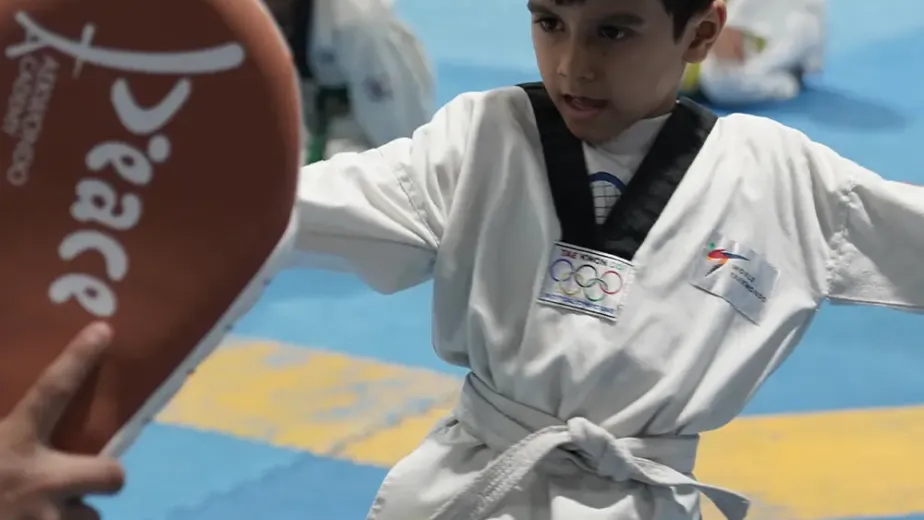
Taekwondo teaches those skills. Not as a side effect of the training. As the direct and intentional outcome of it.
Here are ten of them.
1. Discipline That Comes From Within
Schools reward discipline externally. Children sit still because a teacher is watching. They complete assignments because there are grades and consequences. The compliance is real, but the source is external.
Taekwondo teaches internal discipline. In the training hall, the first person a child learns to control is themselves. Before they can control an opponent in sparring, they must control their own breathing, their own movement, their own impulse to react before they have thought. That process, learning to govern yourself from the inside rather than being governed from the outside, is one of the most valuable lessons a child can receive. And it cannot be administered through a syllabus.
2. Respect as a Practice, Not a Rule
In school, respect is a rule. You address teachers by their title. You do not interrupt. These are important conventions, but they are observed because they are required.
In Taekwondo, respect is a physical practice. Every session begins and ends with a bow. The bow to a coach is an acknowledgement of their knowledge and their role. The bow to a sparring partner before combat is an acknowledgement of their humanity, their effort, and the trust required to train together safely.
Children who practice this daily, who bow before and after every exchange, are not performing a ritual. They are rehearsing a posture toward other human beings that becomes habitual. They carry it off the mat. You can see it in the way they address adults, the way they wait their turn, the way they acknowledge a friend who has done something well.
3. How to Lose, and What to Do Next
Schools have largely eliminated failure. Grades are curved. Competitions are softened. Every child gets a participation certificate. This is well-intentioned, but it produces adults who are extraordinarily poorly equipped for the experience of genuine loss.
Taekwondo does not eliminate failure. It structures it. A child who loses a sparring match has lost a sparring match. There is no softening of that fact. But what happens next is everything. The coach analyses what went wrong. The child understands it was a technique, not a character, that failed them. They come back to training the next day, and they work on exactly the thing that lost them the match.
This is not cruelty. This is one of the most compassionate things you can do for a child. Teaching them that failure is information, that it points toward the work that needs doing, that the only appropriate response to it is to get back on the mat and try again. That lesson, properly absorbed, changes how a person navigates every difficulty they ever face.
A child who learns how to lose in Taekwondo learns something that will serve them in every negotiation, every setback, and every failure they encounter for the rest of their lives.
4. Pressure Management
Examinations are stressful. Performances are stressful. Job interviews are stressful. Life is full of moments where the quality of your output under pressure determines the quality of your outcomes.
Taekwondo is one of the most intensive pressure-training environments a child can enter. Competition puts a child alone on a mat, in front of judges and spectators, against an opponent who is trying to score against them. Everything they have practised must be executed under conditions that are as far from comfortable as possible.
Children who compete in Taekwondo from a young age develop a relationship with pressure that is fundamentally different from children who have never experienced it in a structured context. They know what their body does when adrenaline fires. They know how to regulate their breathing. They know that the panic at the start of a match settles if they trust their training. This knowledge, that they can function well under genuine pressure, is one of the most powerful forms of self-confidence a person can possess.
5. Goal Setting and Long-Term Thinking
The belt system in Taekwondo is one of the most sophisticated goal-setting frameworks ever designed for children. Each belt represents a specific level of skill and knowledge. Achieving it requires consistent training over months. It cannot be rushed, and it cannot be faked. The grading examination is a genuine assessment of whether the child has done the work.
Children who progress through a belt system are learning, at a practical level, how to set a goal, break it down into the daily actions required to achieve it, sustain effort over a long period without immediate reward, and experience the particular satisfaction of achieving something that genuinely required them to grow. These are exactly the habits of mind that distinguish high achievers in every domain from those who could have gone further but did not.
6. Physical Confidence
There is a specific type of confidence that comes from knowing what your body is capable of. Not the abstract self-esteem that schools sometimes try to engineer through positive affirmations, but the grounded, physical confidence that comes from having done hard things with your body and succeeded.
A child who can execute a precise spinning kick, who can hold their balance through a complex combination, who has sparred against someone larger than them and held their ground, that child walks differently. They carry themselves with a quiet physical assurance that is immediately visible to anyone who knows what to look for.
This physical confidence is not arrogance. It is the opposite. It is the settled, grounded confidence of a person who does not need to prove anything because they already know what they are capable of.
7. Teamwork Without a Team Sport
Taekwondo is an individual sport at the competitive level. But it is trained in a group. And this creates one of its most valuable educational dynamics.
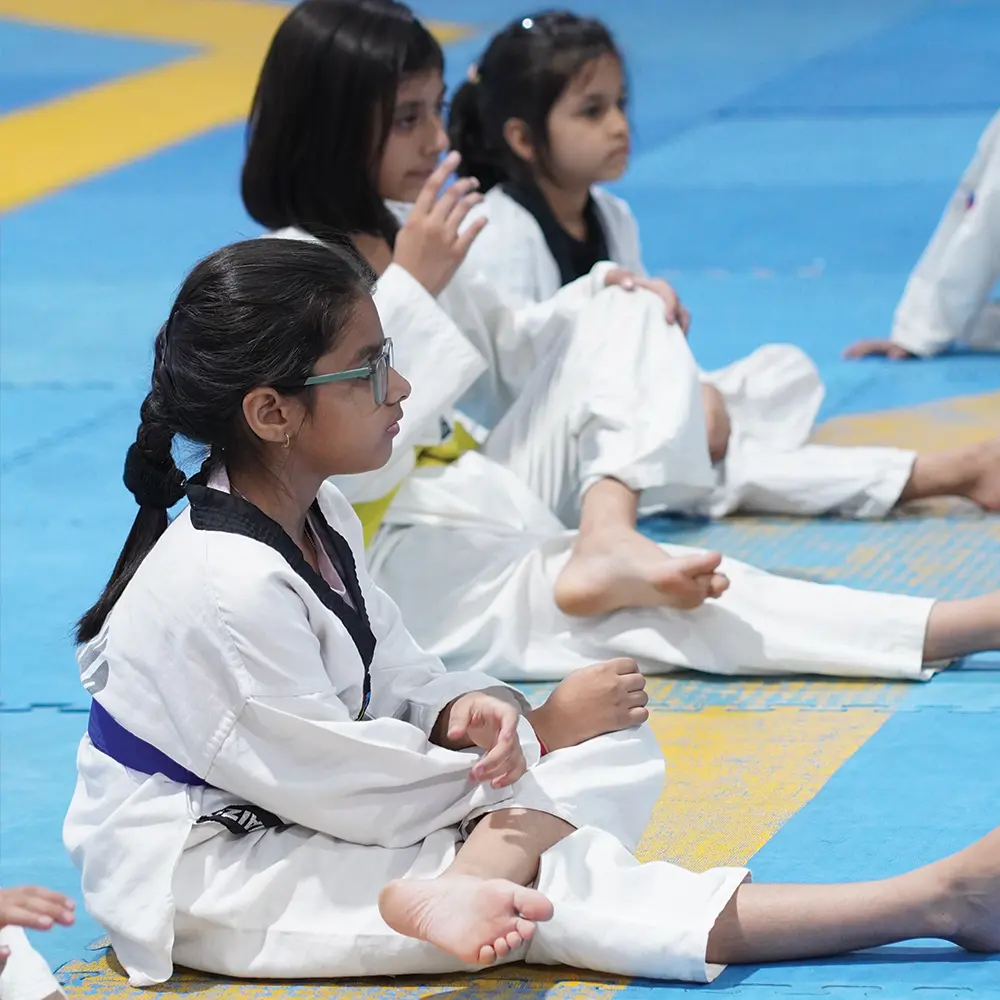
In group training, every athlete’s progress is partially dependent on the quality of their training partners. You cannot develop sparring skills without partners who challenge you appropriately. You cannot develop poomsae precision without training alongside others who hold the standard high. The training group rises and falls together even though the competition is individual.
This teaches children a nuanced form of teamwork. They must support their training partners’ development even while competing against them. They must hold the environment to a high standard because their own development depends on it. They must lead and follow, sometimes in the same session. This is closer to the dynamics of professional life than most team sports, where the roles are fixed, and the scorecard is collective.
8. Self-Defence and Situational Awareness
This is the obvious one, and it remains important. A child who has trained in Taekwondo is not invincible. But they are significantly better equipped than most of their peers to assess a physical threat, to act decisively if necessary, and to de-escalate if possible.
More importantly, training in a martial art develops a quality called situational awareness, the habit of reading the environment around you, identifying potential risks before they materialise, and making decisions accordingly. This is a life skill with applications far beyond self-defence. It is the same quality that makes a good driver, a perceptive manager, and a person who navigates social situations with intelligence and calm.
9. The Ability to Follow a Process
One of the most consistent complaints from employers and educators working with young adults today is that they struggle to follow a process. They want results immediately. They are uncomfortable with the long middle of any endeavour, the period between starting and succeeding when progress is invisible, and the work is just the work.
Taekwondo is almost entirely made of that long middle. The techniques that look effortless in competition have been practised thousands of times before they become reliable. The physical conditioning that allows an athlete to sustain a three-round fight has been built over years of unglamorous daily training. Every session is a process. Almost none of it is a result, in the immediate sense.
A child who trains in Taekwondo for years develops a tolerance for the process that is genuinely rare. They understand at a bodily level that quality takes time, that the accumulation of small, consistent efforts produces results that cannot be shortcut, and that the work itself is worth doing even when the results are not yet visible.
10. Identity Built on Character, Not Comparison
Schools, despite their best efforts, are comparison engines. Children are graded against each other, ranked, sorted by academic performance into implicit hierarchies that can define their sense of self for years.
Taekwondo measures progress against the self. Your last session. Your previous competition. The technique you could not do last month that you can do today. A child’s advancement through the belt system is not determined by how they compare to the child training next to them. It is determined by whether they have met the standard that the art requires.
This creates a fundamentally different relationship with personal identity. The Taekwondo student who achieves a new belt knows they earned it through their own work, measured against an objective standard, not relative to their peers. That is a profoundly healthy basis for self-worth. And it is one that the school system, despite its best intentions, consistently struggles to provide.
A Note for Parents
None of these ten skills is guaranteed outcomes. They are the results of consistent, committed engagement with a sport over time, in an environment where the coaching is good, the values are genuine, and the child is supported through both the highs and the difficult periods.
The school your child attends matters. The friends they make matter. The books they read matter. But where they spend their Tuesday evenings and Saturday mornings, and who is coaching them in that space, and what values that coach is teaching alongside the kicks and the blocks and the sparring, that matters too. Perhaps more than most parents realise.
At Peace Taekwondo Academy, we believe Taekwondo is more than a sport. It is a system for building complete human beings. Our Kids Development Program accepts children from 3 years of age. Book a free trial class at www.peacetaekwondo.com or WhatsApp us at +91 90159 91818.